Tabari Artspace
Skip to main content
  • About
  • Artists
  • Exhibitions
  • Out of frame
  • Menu
  • About
  • Artists
  • Exhibitions
  • Press
  • Publications
  • Contact
  • Out of frame
Menu

Limen: Thresholds / ليمين : الجير وعتبَات أُخرَى: Mohamed Monaiseer, Curated by Hannah Elsisi,

Jan 17, 2025 - Feb 17, 2025

Limen: Thresholds / ليمين : الجير وعتبَات أُخرَى: Mohamed Monaiseer, Curated by Hannah Elsisi

Current viewing_room
  • Hannah Elsisi on Limen: Thresholds 


    A lone figure traverses the foliage of a burial site in Rashid, Egypt. The ashen ground crunches beneath his feet. Birds circle overhead. A cocoon slowly forms. The sweet melodies of a quranic recital can be heard in the distance. 

     
    ***
  • (Larger version of this image opens in a popup).
    (Larger version of this image opens in a popup).
    (Larger version of this image opens in a popup).
    (Larger version of this image opens in a popup).
    (Larger version of this image opens in a popup).
    (Larger version of this image opens in a popup).
    (Larger version of this image opens in a popup).
    (Larger version of this image opens in a popup).
  • Limen, is the firmament or threshold binding things in togetherness and separation. In liminal time-spaces, heterotopias obtain where all manner of ambiguity reigns. Liminality is generative, its ambiguities and contradictions power spiritual, natural and ecological transformations; inscribing resilience in renewal. 


    In Egypt, liman, a colloquial term for prisons still used today, traces its etymology to the Ottoman-Turkish adaptation of the Greek limen. Originally describing the threshold where a ship left the harbour and disappeared from view behind a veil (ghisha’ غشاء) of mist, liman evolved to mean harbour in Ottoman usage. By the 18th century, it indexed shipbuilding yards located along Egypt’s limestone quarries, which were repurposed into convict labour prisons in 19th-century Egypt under Mohammed Ali’s great drive for military expansion. This layered history intertwines the notions of barzakh, thresholds, and liminal spaces, connecting human life-cycles to environmental landscapes and societal structures in flux.

    Central to this exhibition is the concept of liminality in ritual anthropology which resonates with the artist’s long-time meditation on barzakh—an Islamic theological term describing a realm of in-betweenness and transformation. In Sunni and Shia traditions, it represents the intermediary state where souls reside between death and resurrection—a spiritual waiting room shaped by one’s earthly deeds. Sufi interpretations expand this understanding, framing barzakh as a mystical threshold, a space of divine encounter where the physical and spiritual realms dissolve into one another. Often associated with the space between life and death, barzakh also evokes broader thresholds: between land and sea, root and tip, the material and the metaphysical.


    In Limen, these threads converge as Monaiseer stretches barzakh beyond the motifs of the eastern Islamicate world with a meditation on the universality of space-times of in-betweenness: of being neither here nor there, of belonging to this world while existing irretrievably beyond it. Such heterotopias are redolent grounds for navigating historical processes of collective loss, forced migration, political and natural cycles and the anthropocene. 

  • Across Africa too, the concept of barzakh takes on diverse inflexions. In West African Sufi traditions, it is often associated... Across Africa too, the concept of barzakh takes on diverse inflexions. In West African Sufi traditions, it is often associated... Across Africa too, the concept of barzakh takes on diverse inflexions. In West African Sufi traditions, it is often associated... Across Africa too, the concept of barzakh takes on diverse inflexions. In West African Sufi traditions, it is often associated... Across Africa too, the concept of barzakh takes on diverse inflexions. In West African Sufi traditions, it is often associated... Across Africa too, the concept of barzakh takes on diverse inflexions. In West African Sufi traditions, it is often associated...

    Across Africa too, the concept of barzakh takes on diverse inflexions. In West African Sufi traditions, it is often associated with sacred geographies and temporalities, such as the meeting points of rivers and seas or the in-between state of this life and the hereafter. These time-spaces are seen as spiritually potent, echoing the Quranic depiction of barzakh as the “barrier” between saltwater and freshwater. In Moroccan cultural discourse, barzakh extends into earthly practices of burial and remembrance, highlighting the cyclical connection between human life and the land.


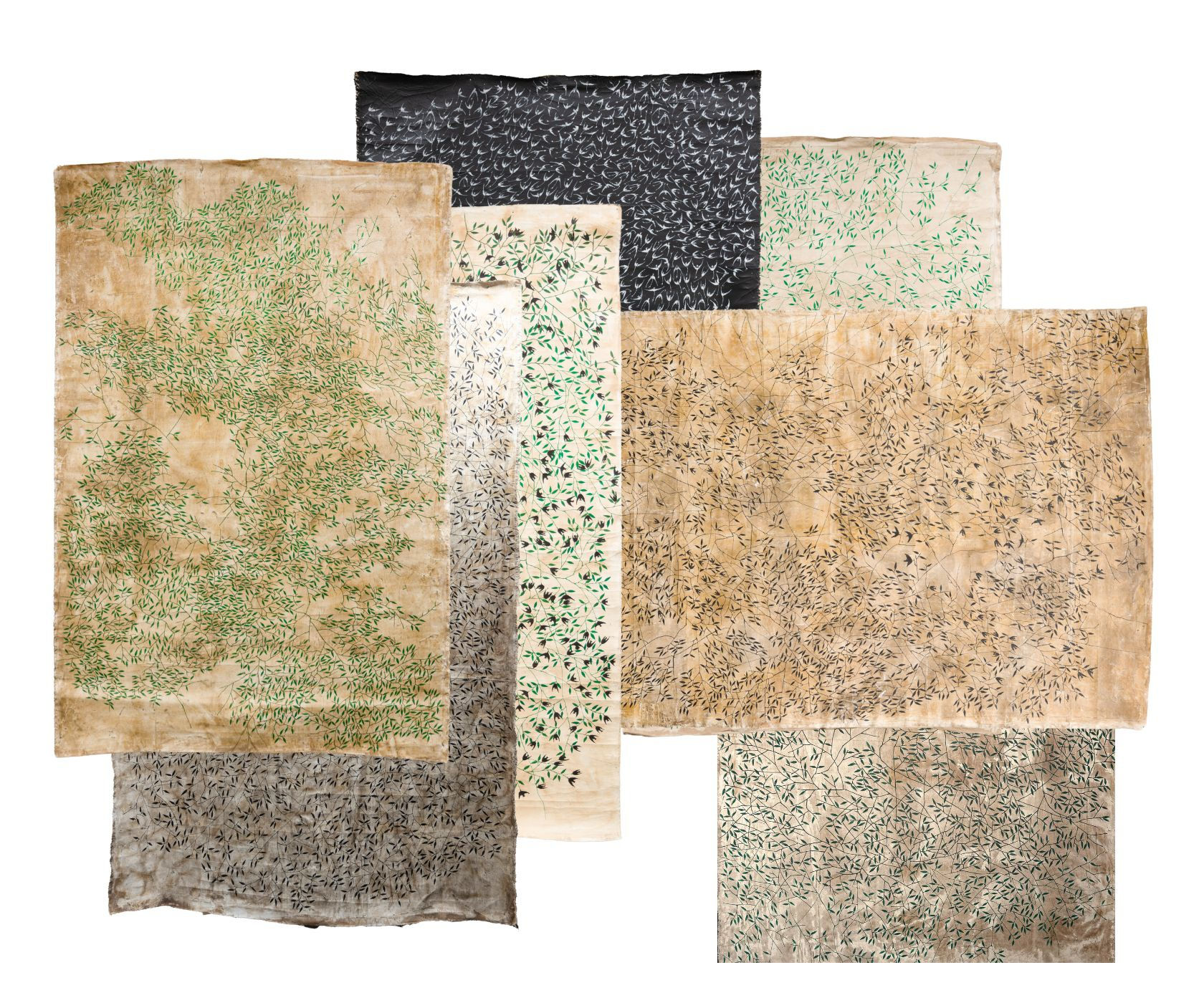
    In this way, Monaiseer engages liminal states through material and conceptual experimentation with temporal and material disjunction. Layered canvases evoke ancient scrolls or burial shrouds adorned with motifs inspired by Quranic ornamentation and burial garlands. Pigment is fashioned from decomposed, ashen leaves and herbs and other site-specific keepsakes. Natural hair installations suggest (plastic) wigs adrift on water, referencing the Middle Passage and more recent Mediterranean crossings in North and West Africa. Barca walla Barzakh! The cry goes inscribed in small pirogue boats fashioned in wood. 

  • The figure of the عنقاء [‘anqaa’] or phoenix, hovers over Limen. From its ashes branch endless roots and leaves. A creature of everlasting renewal in Assyrian mythology, the ‘anqaa’ is an age-old protagonist of ancient Egyptian rituals of the annual passage of migratory birds through the city of the sun (‘An/Heliopolis). In Limen, fragile yet durable materials link ecological degradation to human histories of displacement and resilience. 


    I invite you to follow the lone figure as he tracks the flight of birds risen from the ashes to map liminal journeys between (other) worlds.

    • Barzakh #1
      Barzakh #1
      $ 14,500.00
      View more details
      Sold
    • Barzakh #2
      Barzakh #2
      $ 14,500.00
      View more details
      Sold
    • Barzakh #3
      Barzakh #3
      $ 15,500.00
      View more details
    • Barzakh #4
      Barzakh #4
      $ 16,000.00
      View more details
    • Barzakh #5
      Barzakh #5
      $ 17,000.00
      View more details
    • Barzakh #6
      Barzakh #6
      $ 12,000.00
      View more details
    • Barzakh #7
      Barzakh #7
      $ 12,000.00
      View more details
      Sold
    • Barzakh #8
      Barzakh #8
      $ 8,000.00
      View more details
    • Barzakh #9
      Barzakh #9
      $ 14,500.00
      View more details
      Sold
    • Phoenix #1
      Phoenix #1
      $ 15,500.00
      View more details
      Sold
    • Phoenix #2
      Phoenix #2
      $ 16,500.00
      View more details
      Sold
    • Phoenix #3
      Phoenix #3
      $ 16,500.00
      View more details
    • Phoenix #4
      Phoenix #4
      $ 8,000.00
      View more details
    • Tomb Stone ( 1 )
      Tomb Stone ( 1 )
      $ 4,000.00
      View more details
      Sold
    • Tomb Stone ( 2 )
      Tomb Stone ( 2 )
      $ 5,000.00
      View more details
    • Tomb Stone ( 3 )
      Tomb Stone ( 3 )
      $ 5,000.00
      View more details
    • Tomb Stone ( 4 )
      Tomb Stone ( 4 )
      $ 4,000.00
      View more details
      Sold
    • Tomb Stone ( 5 )
      Tomb Stone ( 5 )
      $ 5,000.00
      View more details
    • Tomb Stone ( 6 )
      Tomb Stone ( 6 )
      $ 5,000.00
      View more details
    • Tomb Stone ( 7 )
      Tomb Stone ( 7 )
      $ 4,000.00
      View more details
      Sold
    • Tomb Stone ( 8 )
      Tomb Stone ( 8 )
      $ 5,000.00
      View more details

Logo

The Gate Village, BUILDING. 3,
Level 2 DIFC UAE 506759
Dubai, United Arab Emirates

OPEN: Monday - Friday
TIME: 10.00 - 18.00
TEL: +971 4 323 0820

Instagram, opens in a new tab.
Artsy, opens in a new tab.
Join the mailing list
Manage cookies
Copyright © 2024 Tabari Artspace
Online Viewing Rooms by Artlogic

This website uses cookies
This site uses cookies to help make it more useful to you. Please contact us to find out more about our Cookie Policy.

Manage cookies
Reject non essential
Accept

Cookie preferences

Check the boxes for the cookie categories you allow our site to use

Cookie options
Required for the website to function and cannot be disabled.
Improve your experience on the website by storing choices you make about how it should function.
Allow us to collect anonymous usage data in order to improve the experience on our website.
Allow us to identify our visitors so that we can offer personalised, targeted marketing.
Save preferences
Close

Join our mailing list

Signup

* denotes required fields

We will process the personal data you have supplied in accordance with our privacy policy (available on request). You can unsubscribe or change your preferences at any time by clicking the link in our emails.